
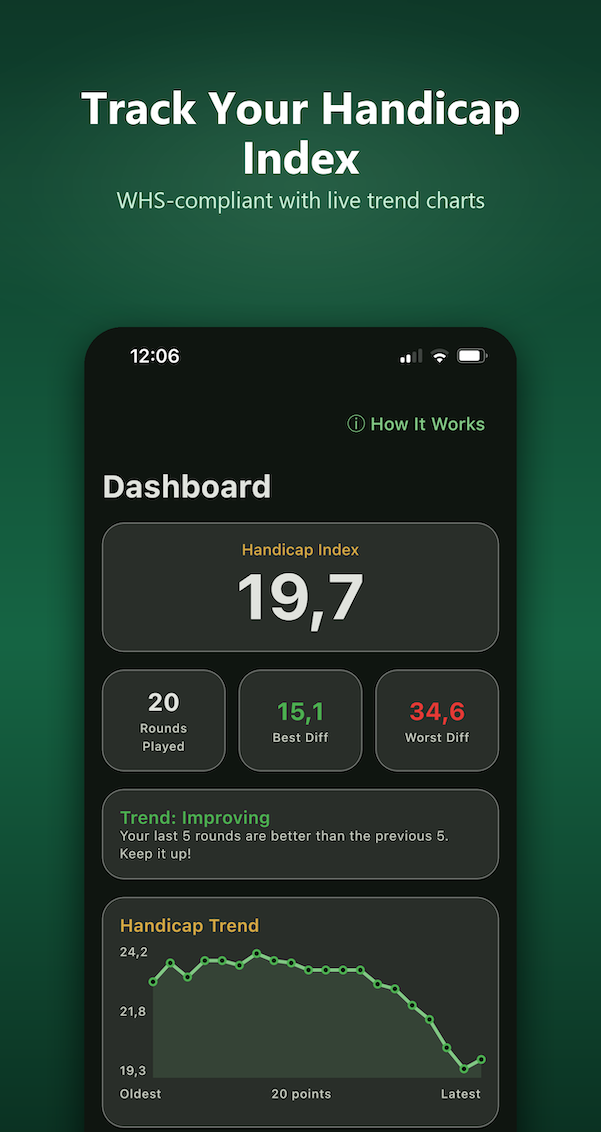
You played the round of your life last weekend. A 78 on a tough course. You logged it, expected your handicap to tumble, and… it dropped 0.2. Maybe 0.3 if you were lucky.
This is the most common frustration among amateur golfers tracking their handicap under the World Handicap System (WHS): the gap between how you feel about your game and how the number moves on the screen.
This article explains exactly why your handicap behaves the way it does, what score you actually need to shoot to lower your golf handicap by one full stroke, and how to project the change before you play.
How the WHS Handicap Index Is Actually Calculated
Under the World Handicap System — the global standard adopted across Europe in 2020 — your Handicap Index is the average of the best 8 Score Differentials from your most recent 20 rounds.
That sentence contains the answer to almost every „why didn’t my handicap drop?“ question. Let’s break it down.
A Score Differential is calculated for each round you log:
(Adjusted Gross Score − Course Rating) × 113 ÷ Slope Rating
So if you shoot 85 on a course with a Course Rating of 71.3 and a Slope Rating of 124, your differential is:
(85 − 71.3) × 113 ÷ 124 = 12.5
That differential is stored in your record. When your record contains 20 rounds, the system picks the 8 lowest differentials, averages them, and rounds to one decimal. That’s your Handicap Index.
Everything else — the soft caps, the hard caps, the Playing Conditions Calculation — is fine-tuning around this core rule.
Why Your Handicap Barely Moved After a Great Round
Here’s the part most golfers miss. Imagine your scoring record looks like this:
- 20 rounds logged
- Your current 8 best differentials average to 15.2
- Your 8th-best differential (the worst one currently counting) is 17.1
Now you shoot a great round. Differential: 13.5.
What happens? The new differential of 13.5 replaces the 17.1 in your best-8 set. The math is simply:
(Old 8 differentials + 13.5 − 17.1) ÷ 8
The improvement to your average is (17.1 − 13.5) ÷ 8 = 0.45 strokes.
Your handicap drops from 15.2 to roughly 14.8. That’s it. One single great round can never move your index by more than a fraction — because it’s diluted across 8 differentials.
This is by design. The WHS is meant to measure your potential ability across time, not your hottest streak. But it explains why a 78 feels like it should be a bigger deal than the system makes it.
What Score Do You Need to Lower Your Handicap by 1 Full Stroke?
Short answer: you need to replace your worst counting differential with one that’s 8 strokes lower — because the change in your average is the difference, divided by 8.
To drop your handicap by 1.0, the math is:
New differential = Current 8th-best differential − 8.0
So if your 8th-best differential right now is 17.1, you need a single round that produces a differential of 9.1 or lower to drop your index by 1.0.
On a course with a Slope Rating of 124 and Course Rating of 71.3, a differential of 9.1 means a gross score of:
71.3 + (9.1 × 124 ÷ 113) = 81.3
So a single 81 in those conditions drops your handicap by exactly one stroke — if it replaces your current worst counting round.
Of course, most golfers don’t know what their 8th-best differential currently is. That’s where most of the frustration comes from: you’re playing blind. You don’t know whether tomorrow’s round will move your number or not.
The „Drop-Off“ Round Nobody Talks About
Here’s something even experienced golfers underestimate: your handicap shifts every time you log a round, even if your new round doesn’t make the best-8 cut.
Why? Because logging a 21st round pushes your oldest round out of the 20-round window. If that oldest round was bad (and not currently in your best-8 anyway), nothing happens. But if it was good, and it was one of your counting 8, it drops out — and a worse differential takes its place.
This means you can play a mediocre round, log it, and watch your handicap go up — not because the new round was bad, but because a good old round disappeared.
This single mechanic explains why some weeks your handicap moves and other weeks it doesn’t, even when the actual scores feel identical. The system isn’t broken. You’re just not seeing which round dropped off.
How to Lower Your Golf Handicap Faster (and Smarter)
Beyond the obvious „play better“ advice, there are a handful of practical tactics that work with the WHS math, not against it:
1. Log every acceptable round. The more rounds in your record, the more chances you have to push a high differential out of your best-8. Skipping bad rounds doesn’t help — it just slows down the replacement cycle.
2. Watch which rounds are about to drop off. If your oldest round is a brilliant one, you can mentally prepare for your handicap to drift up a tenth or two when it ages out. If your oldest round is poor, you have a structural tailwind coming.
3. Track your differentials, not just your scores. A 90 on an easy course and an 85 on a hard course can produce identical differentials. The course difficulty (rating and slope) is doing most of the math.
4. Focus on consistency, not heroics. Because your best 8 of 20 count, a player who shoots 84 every week will out-handicap a player who alternates between 78 and 92. Variance hurts under WHS.
5. Understand the soft cap. If you go through a rough patch, the WHS will protect you from your handicap rising too fast — but it won’t protect you from a slow climb of soft-cap-adjusted strokes. Coming back from a slump takes more deliberate good rounds than most expect.
The Smarter Way: Predict Your Handicap Before You Play
The biggest practical problem with the WHS isn’t the math — it’s the invisibility of the math. Most apps and club systems show you what your handicap is. None show you what it’s about to become.
This is exactly the gap our Golf Handicap – Track & Plan App was built to fill. It shows three things no other handicap tracker does:
- Next Round Preview — see exactly which round in your scoring record is about to drop off, and how your handicap will shift the moment you log your next score.
- Handicap Projector — type any hypothetical score for any course, and instantly see what your new Handicap Index would become. Useful for setting realistic targets before you tee off.
- Goal Milestones — set a target Handicap Index and a date, and the app tracks your pace toward it.
It’s WHS-compliant, works offline, requires no account, and your data never leaves your phone. Free to use; the predictor features are available as a one-time purchase.
Frequently Asked Questions
How long does it take for my golf handicap to update?
Under the WHS, your Handicap Index is recalculated each time you submit an acceptable score. Most national golf federations push the update within 24 hours. Some clubs only sync overnight, so if you log a round in the evening you may not see the new index until the next morning.
Why did my handicap go up when I played a normal round?
Most likely, the round that just dropped out of your 20-round window was one of your best-8 counting differentials. When a good round ages out, a previously non-counting (and worse) differential takes its place, which raises your average. The new round you logged didn’t cause the increase — the disappearance of an old good one did.
How many rounds do I need to get an official Handicap Index?
You need a minimum of 54 holes submitted, which can be any combination of 9-hole and 18-hole rounds. Most golfers get there with three 18-hole rounds.
Can my handicap go below 0?
Yes. A „plus“ handicap (written as +2.4, for example) means you’re expected to shoot under the Course Rating. The WHS supports indexes down to roughly −10 and up to a maximum of 54.0.
What is the maximum handicap index under WHS?
The maximum Handicap Index is 54.0 for both men and women. This is a change from older national systems, which sometimes capped at 28 or 36 for tournament play.
Does a single bad round ruin my handicap?
No. A single bad round will only affect your index if its differential is better than your current 8th-best — which by definition means it isn’t a bad round. Truly bad rounds never enter the best-8 calculation. They sit in your record as the worst 12 of 20 and are ignored for index purposes.
Summary
Your handicap moves slowly because it’s a moving average of your best rounds, not your most recent ones. To drop your index by a full stroke, you need a single round with a differential roughly 8 strokes lower than your current worst-counting round.
The math is fair, but it’s invisible — which is why most golfers feel like their handicap is „stuck“ even when their game is improving. Knowing which round is about to drop off, and what score you need to shoot to move the number, turns the WHS from a black box into a planning tool.
If you’d like to see those projections automatically for your own scoring record, you can download the Golf Handicap App on the App Store or Google Play.
For a complete breakdown of the formula itself — including
how the USGA and WHS systems became identical after 2020
and why a 0.96 multiplier no longer applies — see our deep
dive on the golf handicap formula.