
If you’ve ever looked at your scorecard, written down a respectable number, and then wondered how your golf federation turned it into a Handicap Index — you’re not alone. The math behind the World Handicap System (WHS) is publicly documented, but it’s scattered across rulebooks, federation FAQs, and forum threads.
This guide walks through the full calculation, step by step, with worked examples. By the end you’ll know exactly how to go from a raw score on a scorecard to an official Handicap Index — and from there to the Course Handicap you actually play off.
What You Need Before You Start
Before any calculation, you need four data points for every round:
- Your gross score — the total strokes you took, before any adjustments.
- Course Rating — printed on the scorecard. Expressed to one decimal (e.g. 72.1). Represents the expected score for a scratch golfer from a specific set of tees.
- Slope Rating — also printed on the scorecard. A whole number between 55 and 155 that measures how much harder the course plays for a bogey golfer compared to a scratch golfer. The reference value is 113.
- Par — the total par for the tees you played.
You don’t need anything else. No memberships, no apps, no proprietary tools. Just these four numbers and a calculator.
Step 1: Calculate Your Adjusted Gross Score
Your gross score isn’t used directly. WHS first caps your score on each hole at net double bogey, which prevents one disaster hole from inflating your handicap unfairly.
Net double bogey for a hole equals:
Par + 2 + any handicap strokes you receive on that hole
If you receive one stroke on a par 4, your net double bogey is 4 + 2 + 1 = 7. Any score higher than 7 on that hole gets adjusted down to 7 for handicap purposes.
If you didn’t pick up or blow up on any hole, your Adjusted Gross Score equals your gross score. For most golfers, this is the case on most rounds.
Step 2: Calculate the Score Differential
This is the heart of WHS. The Score Differential converts your round into a number that’s directly comparable to rounds played on any other course in the world.
The formula:
Score Differential = (Adjusted Gross Score − Course Rating − PCC) × 113 ÷ Slope Rating
PCC stands for Playing Conditions Calculation — a daily adjustment between −1 and +3 that your federation applies automatically when weather or course conditions significantly affected scoring that day. For your own back-of-envelope math, you can ignore it (treat it as 0).
Worked example. You shoot 85 on a course with a Course Rating of 71.3 and a Slope Rating of 124.
(85 − 71.3 − 0) × 113 ÷ 124 = 13.7 × 113 ÷ 124 = 12.5
Your Score Differential for that round is 12.5. This is the number that goes into your scoring record.
Notice what just happened: the same 85 on an easier course (say Slope 110) would produce a higher differential, because the course was easier and your score is less impressive. The same 85 on a harder course (Slope 140) would produce a lower differential. This is exactly what WHS is designed to do — normalize your scores across different courses so they can be compared fairly.
Step 3: Build Your Scoring Record
To get an official Handicap Index, you need a minimum of 54 holes submitted. That can be any combination of 18-hole and 9-hole rounds (9-hole scores are automatically converted to 18-hole differentials by the system).
Until you reach 20 rounds, WHS uses a sliding scale that takes the average of your best few differentials, with small adjustments. The scale gradually shifts toward „best 8 of 20“ as your record grows.
Once you have 20 rounds in your record, the calculation locks into its final form: average the 8 lowest Score Differentials from your most recent 20 rounds. Round to one decimal. That’s your Handicap Index.
Worked example. Imagine these are your 20 most recent Score Differentials, sorted lowest to highest:
9.1, 10.4, 11.2, 11.8, 12.5, 13.0, 13.4, 13.9, 14.2, 14.6, 15.1, 15.8, 16.3, 16.9, 17.2, 17.5, 18.0, 18.4, 19.2, 21.5
The lowest 8 are: 9.1, 10.4, 11.2, 11.8, 12.5, 13.0, 13.4, 13.9.
Average: (9.1 + 10.4 + 11.2 + 11.8 + 12.5 + 13.0 + 13.4 + 13.9) ÷ 8 = 95.3 ÷ 8 = 11.91 → Handicap Index of 11.9
Everything else in your record — the 12 worst differentials — is simply ignored for index purposes. They sit in your record but don’t affect the number.
Step 4: Convert Your Handicap Index Into a Course Handicap
Your Handicap Index is portable. It works the same anywhere in the world. But it doesn’t yet tell you how many strokes you actually get on a specific course. That’s what the Course Handicap is for.
The formula:
Course Handicap = Handicap Index × (Slope Rating ÷ 113) + (Course Rating − Par)
Worked example. Your Handicap Index is 11.9. You’re playing a course with Slope 130, Course Rating 72.4, Par 72.
11.9 × (130 ÷ 113) + (72.4 − 72) = 11.9 × 1.150 + 0.4 = 13.69 + 0.4 = 14.09 → Course Handicap of 14
The result is rounded to the nearest whole number when applied for net double bogey limits during play. On an easier course (lower Slope, lower Rating) the same Handicap Index would produce a lower Course Handicap. This is how WHS keeps competition fair across different courses.
Step 5 (Optional): Apply the Format Allowance
For competition play, the Course Handicap is multiplied by a format-specific allowance to give your Playing Handicap:
- Individual stroke play and Stableford: 95%
- Singles match play: 100%
- Four-ball better ball: 85% (stroke play) or 90% (match play)
- Foursomes alternate shot: 50% of combined team handicap
For recreational rounds you can usually skip this step. It only matters in formal competitions.
Common Mistakes When Calculating a Golf Handicap
Using the wrong tees. Course Rating and Slope are different for each set of tees. Make sure you’re using the values for the tees you actually played.
Forgetting to adjust for net double bogey. If you triple-bogeyed a par 3 where you got no strokes, your maximum score for handicap purposes is 5, not 6. This rarely changes a beginner’s differential by much, but it adds up.
Using gross score instead of Adjusted Gross Score. Even one capped hole changes the differential. Always do Step 1 before Step 2.
Confusing Course Handicap with Playing Handicap. Course Handicap is just for net double bogey adjustments. Playing Handicap (after the format allowance) is what determines strokes received in a competition.
Calculating from raw scores when you should be calculating from differentials. Your Handicap Index is the average of the best 8 differentials, not the best 8 scores. Two rounds with the same gross score on different courses produce different differentials.
Why Most Golfers Don’t Do This Calculation By Hand
Reading the steps above, you can see why almost no recreational golfer manually calculates their handicap. The math is straightforward — but it depends on accurate Course Rating and Slope values for every course you play, plus a running record of your last 20 rounds, plus reliable adjustment for net double bogey and PCC.
For an official Handicap Index, you have to be a member of an authorized golf club affiliated with your national federation, who maintain the record for you. The number you see in the GHIN app, the DGV app, England Golf, or your local equivalent is your official index.
The gap is that those official systems show you what your handicap is, but not what it’s about to become if you play a particular score tomorrow. Most golfers want to know that before they tee off, not after.
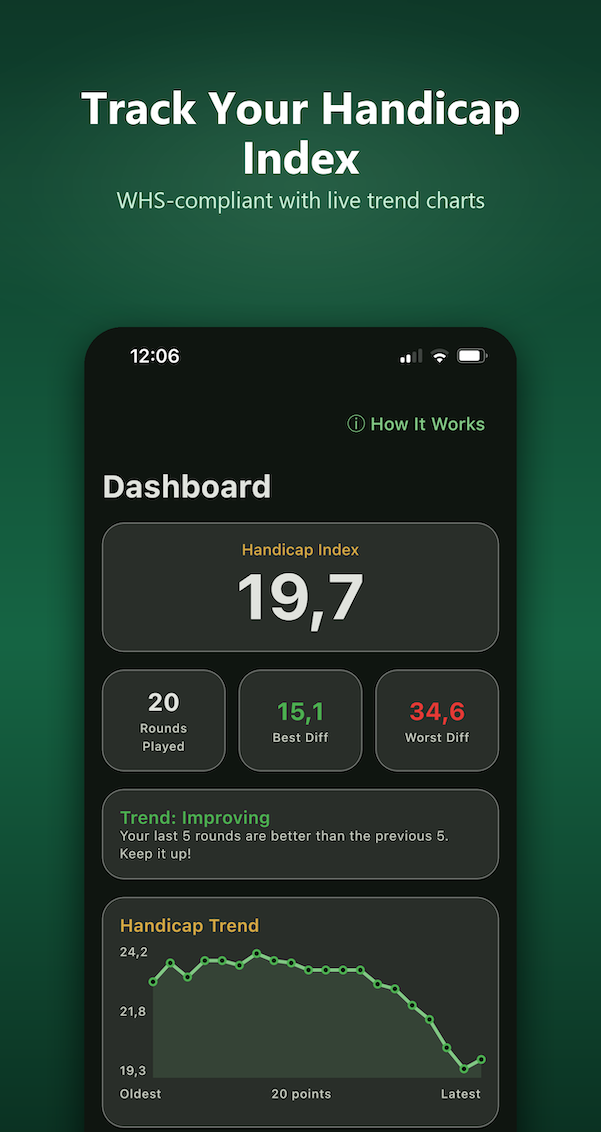
This is the gap our Golf Handicap – Track & Plan App was built to fill. It runs the full WHS calculation on your phone, instantly. You can type any hypothetical score for any course and see exactly what your new Handicap Index would become. It’s WHS-compliant, works offline, requires no account, and your data stays on your device.
If you want to understand the math in even more practical detail — like why your handicap barely moves after a great round — see our companion article on why your handicap moves slowly even when you play well.
For US Golfers: Same Calculation, Different Platform
If you’re a US golfer who landed here from a search for „USGA handicap calculation,“ everything above applies to you exactly as written. Since the 1st of January 2020, the United States Golf Association uses the World Handicap System — the same formula, the same Score Differentials, the same „best 8 of 20“ averaging rule that applies to golfers in Germany, the UK, Australia, and 60+ other countries.
The only differences are administrative, not mathematical:
- In the US, your handicap record lives in GHIN (the Golf Handicap and Information Network)
- In Europe, each national federation maintains its own platform (DGV in Germany, England Golf in the UK, etc.)
- In the US, you submit scores through your club, an authorised app, or the GHIN portal
- Course Rating and Slope Rating values are published by your state golf association (or equivalent)
But every number that gets fed into the formula — your Adjusted Gross Score, the Course Rating, the Slope Rating, the daily PCC adjustment — works identically. The „USGA handicap formula“ you’ll see referenced in older articles (with a 0.96 multiplier or „Bonus for Excellence“ adjustment) no longer exists. Those were legacy elements from the pre-2020 USGA Handicap System, retired when the USGA adopted WHS.
What this means in practice for US golfers
If you want to calculate your handicap manually from a recent round, follow the steps above exactly. The formula is:
Score Differential = (113 / Slope Rating) × (Adjusted Gross Score − Course Rating − PCC)
Average the lowest 8 of your most recent 20 Score Differentials, and that’s your Handicap Index. There is no separate calculation path for US players, no different multiplier, no different averaging window.
If you’re confused by older guides showing different formulas, that’s because most US-focused content online still hasn’t been updated for the WHS transition. For a complete breakdown of the formula itself — including a side-by-side debunking of the „USGA vs WHS“ myth and the variables in detail — see our deep dive on the golf handicap formula.
A note on Course Handicap vs Handicap Index
One source of confusion specifically for US golfers: the GHIN portal often shows two numbers — your Handicap Index and your Course Handicap. The Index is the portable number that the formula above produces. The Course Handicap is what you actually receive on a specific set of tees, calculated as:
Course Handicap = Handicap Index × (Slope Rating / 113) + (Course Rating − Par)
This is the number that determines your strokes for net play on a given day, and it changes from course to course. The Handicap Index does not.
Frequently Asked Questions
How many rounds do I need to get my first Handicap Index?
A minimum of 54 holes, in any combination of 9-hole and 18-hole rounds. That’s typically three 18-hole rounds or six 9-hole rounds. Until you reach this minimum, your status will show as „No Handicap“ or a provisional value.
What is the difference between a Course Rating and a Slope Rating?
Course Rating is the expected score for a scratch golfer (usually between 67 and 77). Slope Rating measures how much harder the course is for a bogey golfer compared to a scratch golfer (between 55 and 155, with 113 as standard). Course Rating tells you the absolute difficulty; Slope Rating tells you how that difficulty scales with skill level.
Why is 113 in the formula?
113 is the Slope Rating of a course of average relative difficulty. It serves as a reference constant so that differentials from any course can be compared on the same scale. For a deeper look at why this number is in the formula and how the full USGA/WHS calculation works, see our complete guide to the golf handicap formula.
How often is my Handicap Index updated?
Under WHS, your index is recalculated whenever you submit a new acceptable score. Most national federations push the update within 24 hours. Some clubs sync only overnight, so you may see the new number the morning after you log a round.
What is the maximum Handicap Index?
54.0 for both men and women. This is a change from older national systems, which sometimes capped indexes at 28 or 36. Committees may apply lower eligibility limits for specific tournaments.
Can I calculate my handicap if I’m not a club member?
You can run the calculation yourself to estimate your handicap, but only an authorized golf club affiliated with your national federation can issue an official Handicap Index that’s recognized in competition. Many apps, including ours, let you track an unofficial index that follows the same WHS formula.
Does WHS use multiplication by 0.96 anywhere?
Some older sources reference a 0.96 multiplier applied to the average of best differentials. This was part of the legacy USGA system before WHS. Under current WHS rules (since 2020), no 0.96 multiplier is applied — the Handicap Index is simply the average of the best 8 differentials, rounded to one decimal.
Summary
To calculate your golf handicap under the World Handicap System, you take each round’s Adjusted Gross Score, convert it into a Score Differential using the Course Rating and Slope Rating, and then average the best 8 differentials from your most recent 20 rounds. That gives you your Handicap Index. To play off it on any specific course, multiply by Slope ÷ 113 and add (Course Rating − Par) to get your Course Handicap.
The math is fair, transparent, and globally standardized — but it requires real-time access to course data and a complete scoring record. For most golfers, the calculation is run automatically by their federation, which makes the result available but the reasoning invisible.
If you’d like to see the full calculation for your own scores, project what your handicap would be after tomorrow’s round, or set a goal index to work toward, you can download the Golf Handicap App on the App Store or Google Play.